 Malaga City Guide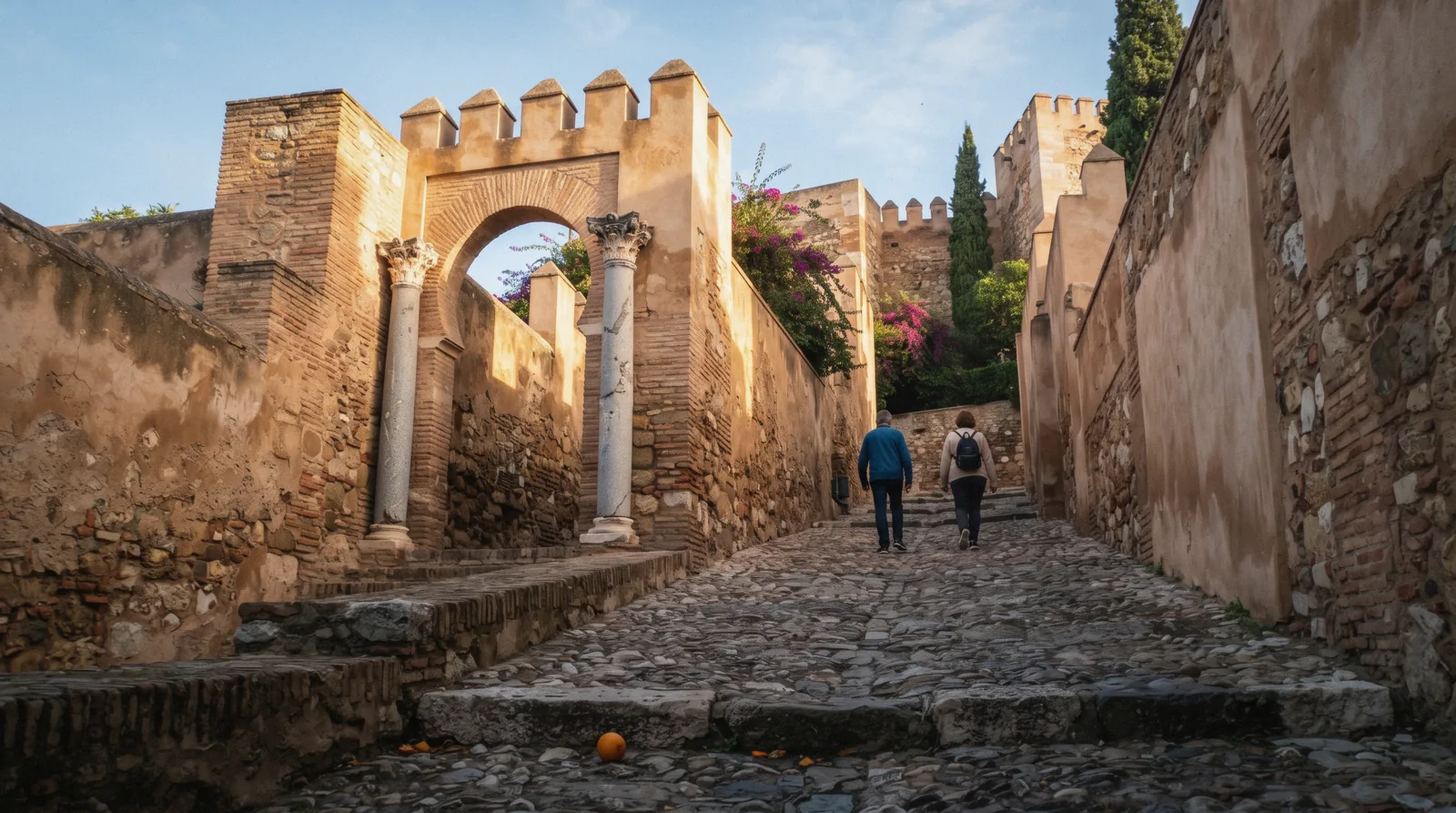
Alcazaba de Málaga
The Alcazaba Málaga visitors climb from Calle Alcazabilla is an eleventh-century palace-fortress on the western spur of Monte Gibralfaro, run by the Ayuntamiento de Málaga and open every day of the week. This page carries the official hours by season, the free-Sunday rule, the ticket ladder against the resold cards, the lift that skips the entrance ramp, what the five gates and two palaces actually contain, and how the climb connects to Gibralfaro Castle above and the Roman Theatre below. The ticket comparison in full is on the Alcazaba tickets page. The rest of the city's sights are ranked on things to do in Málaga.
Quick answer Price, hours, the free Sunday and the lift, in four lines
The Alcazaba opens every day at 09:00, closing at 20:00 from April to October and at 18:00 from November to March, with last admission one hour before. Entry is $8.16 (€7), or $11.65 (€10) on the combined ticket that also opens Gibralfaro Castle, and it is free for everyone every Sunday from 14:00.
Key takeaways
- There is no timed slot and no obligation to book: the monument's own shop and the gate sell the same $8.16 (€7) ticket, so the resold entry cards buy nothing extra, while the 90-minute guided walk with entry is priced close to the gate fee and adds a guide
- The official visit page names a lift from Calle Guillén Sotelo as an alternative entrance, which skips the ramp and the first three gates. Whether it is running on the day is not published, so read the access section before you plan around it
- The combined ticket is the better buy if you are climbing to Gibralfaro Castle the same day, a 20-minute uphill walk from the Alcazaba foot, and the Roman Theatre at the gate is free at all times
Key facts
Opening hours
| Daily, 1 April to 31 October | 09:00–20:00 |
|---|---|
| Daily, 1 November to 31 March | 09:00–18:00 |
| Last admission, all year | one hour before closing: 19:00 in summer, 17:00 in winter |
Closed None printed on the official hours page. No 25 December or 1 January closure is listed, so ask at the gate on those two days
Admission
- Adult
- $8.16 (€7) Alcazaba only. $11.65 (€10) Alcazaba and Gibralfaro combined
- Reduced
- $3.50 (€3) single, $5.83 (€5) combined: European Youth Card, EU citizens 65+, retired or unemployed, EU students, disability of 33% or more, large-family card. Groups of more than 10 pay $5.83 (€5) or $9.32 (€8)
- Free
- Under 6. Every Sunday from 14:00 for everyone. Accredited guides and authorised press
Planning it
- Time needed
- Not stated by the monument. Our routing: 1 hour for the gates and the palaces, 1 h 30 with the gardens and the walls, half a day with Gibralfaro on top
- Book ahead
- Optional — walk-up usually fine
- Address
- Calle Alcazabilla 2, 29012 Málaga. Lift entrance on Calle Guillén Sotelo
Six ways to hold an Alcazaba ticket, the two official ones first, priced from alcazabaygibralfaro.malaga.eu and from the operators' listings as read in Q3 2026. The gate price is the anchor: every resold entry card sits above it, and the two guided walks are the only rows that add something the monument does not sell.
Are you paying for the gate, or for someone to walk the gates with you?
| Option | Price | Includes | Cancel | Book |
|---|---|---|---|---|
| Official ticket, Alcazaba onlyThe default. Buy at the gate or on the monument's own shop. There is no queue-skipping to pay for because there is no timed entry. | $8.16 (€7) adult. $3.50 (€3) reduced. Free under 6 and Sundays from 14:00 | Entry, self-guided, no time slot | Not stated on the official page | Official site |
| Official combined ticket, Alcazaba and GibralfaroAnyone climbing to the castle the same day. The saving is $4.66 (€4) over two singles. The validity window is not printed on the official page. | $11.65 (€10) adult. $5.83 (€5) reduced | Both monuments, self-guided | Not stated on the official page | Official site |
| Guided walk, Roman Theatre and Alcazaba, 1 h 30First-time visitors who want the gates and palaces explained. The price is about $6.50 over the gate fee for a 90-minute guide. | $14.66 as listed | Alcazaba entry, licensed guide, you stay inside afterwards | Free up to 24 hours before | Check Availability |
| Guided walk with both entries, 1 h 30The cheapest guided row. 40 minutes in the theatre and 40 in the fortress, back at the glass pyramid at the end. | $13.96 as listed | Alcazaba entry, theatre visit, guide in English or Spanish | Free up to 24 hours before. Late arrivals not admitted | Check Availability |
| Resold entry ticket, Alcazaba onlyOnly if the official shop will not take your card. It is the same gate at more than double the price. | $18.61 as listed | Entry only, official ticket emailed the day before | Free up to 24 hours before | Check Availability |
| Resold combined ticket with audio tourBuyers who want a commentary on both hills. The official combined ticket is $11.65, so the audio is what the difference pays for. | $26.24 as listed | Alcazaba and Gibralfaro entry, phone audio tour, valid all day | Free up to 24 hours before | Check Availability |
The official rows link to the Ayuntamiento's own ticket shop with no tracking of ours. Platform prices move with the date. The figure that counts is the one at checkout. Two reseller listings warn in their own reviews that the official ticket was cheaper on site, and this table agrees with them.
Alcazaba Tours and Tickets Compared
Every card links to the operator's own page, where the calendar shows the departure times still open for your date. Prices are in US dollars as listed in Q3 2026. The gate itself charges $8.16 (€7).
 from $14.66
Most reviewed
from $14.66
Most reviewed Málaga: Alcazaba and Roman Theatre Guided Tour With Entry
A 90-minute guided walk that starts at the Roman Theatre and ends inside the Alcazaba, fortress entry included, in English, Spanish or Italian. You are left inside the Alcazaba at the end to stay as long as you like; the tour does not go up to Gibralfaro Castle.
Check Availability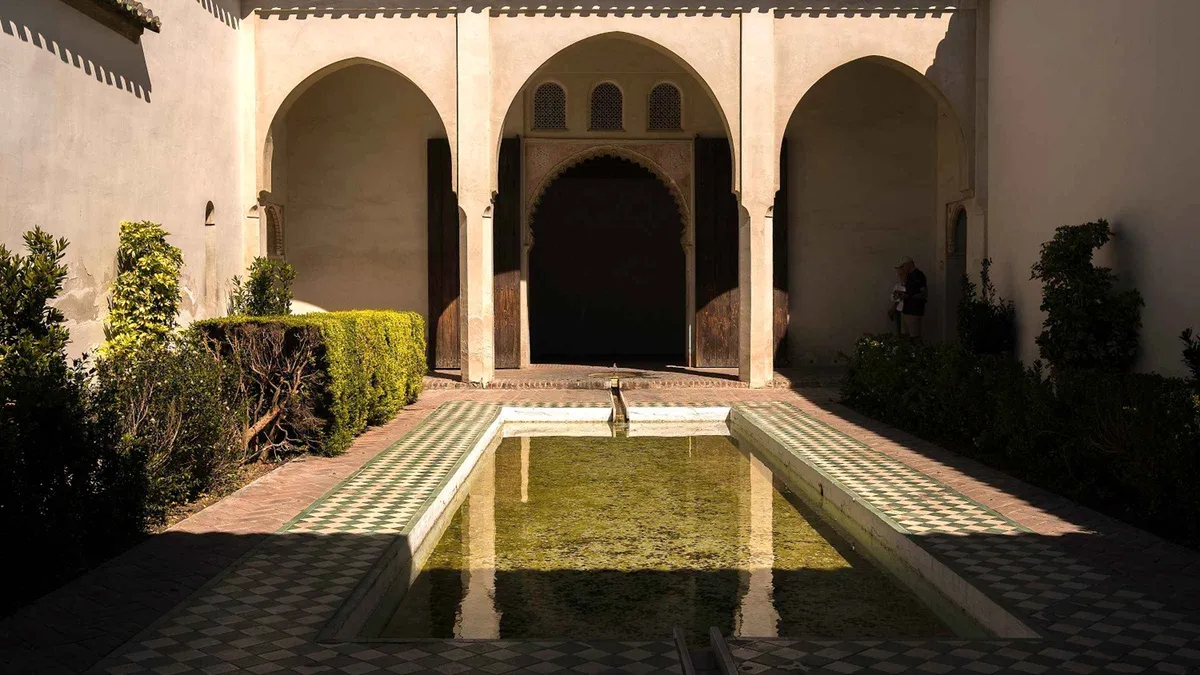 from $13.96
Cheapest entry
from $13.96
Cheapest entry Malaga: Alcazaba & Roman Theatre Tour with Entry Tickets
Ninety minutes with an official guide split evenly between the Roman Theatre and the Alcazaba, both admissions in the price, in English or Spanish. It starts and finishes at the glass pyramid on Calle Alcazabilla; late arrivals are not admitted and are not refunded.
Check Availability from $18.61
Malaga: Alcazaba Entry Ticket
A resold Alcazaba admission with no guide and no Gibralfaro: the operator emails the official tickets the day before, and the GetYourGuide voucher itself is not accepted at the gate. Bring ID. It only makes sense if you cannot use the monument's own online shop.
Check Availability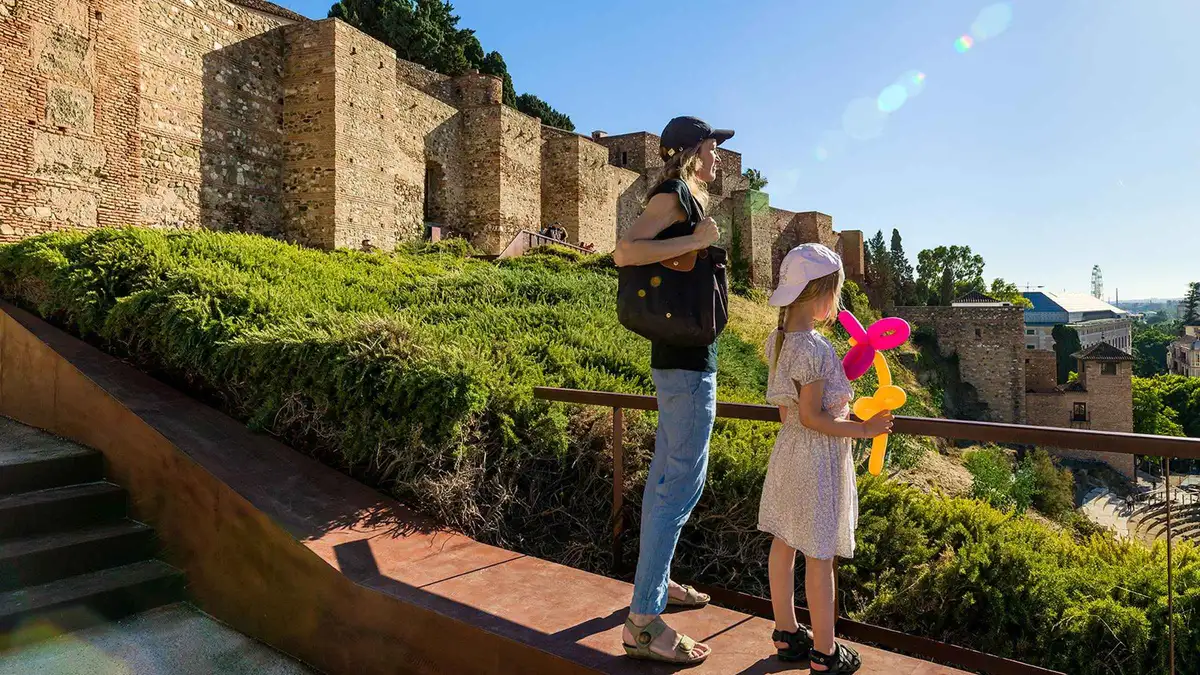 from $26.24
Malaga: Alcazaba and Castillo de Gibralfaro Tour with Official Audio Guide
A resold all-day combined ticket for the Alcazaba and Gibralfaro Castle with an audio tour; the GetYourGuide voucher is not valid for entry, the official tickets come by email the day before. No guide, no transport up the hill. One reviewer missed Gibralfaro by arriving after last entry.
Check Availability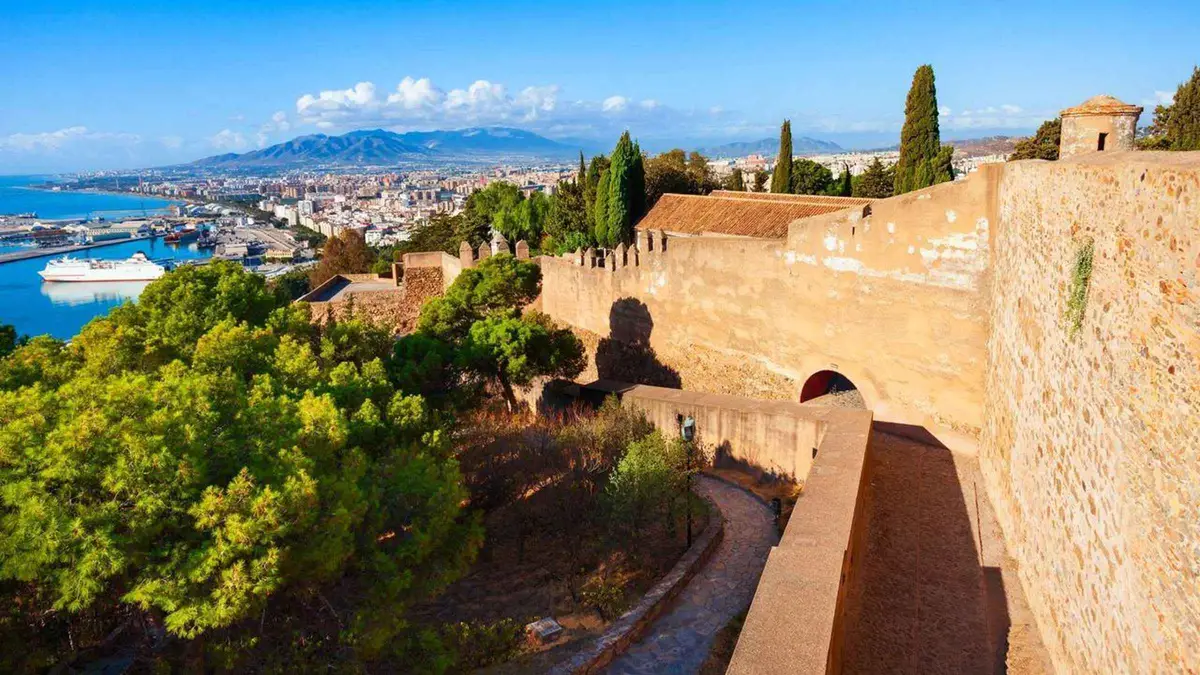 from $29.08
Malaga: Alcazaba & Gibralfaro Castle Entry with Audio Guide
Both hilltop fortresses on one self-guided ticket with a phone-based audio commentary in five languages. Nothing is timed and there is no guide; you walk the uphill path between the Alcazaba and Gibralfaro yourself and bring your own headphones. The price is roughly triple the official combined ticket.
Check AvailabilityPrices, ratings and details are the platform's own; dollar figures are the listed prices — the platform bills in your account's currency.
What the Alcazaba Is, and Why It Climbs the Way It Does
A Phoenician hill, a Roman quarry, an Umayyad fort, a Hammudid palace, a Nasrid rebuild and a slum cleared in the 1930s. The Alcazaba you walk is mostly the eleventh and fourteenth centuries, restored in the twentieth.
From Phoenician Wall to Hammudid Palace
The hill was occupied around 600 BC by the Phoenicians, and the Romans who followed them built the theatre into its western slope in the first century. The official history page records the first Alcazaba under Abd al-Rahman I in 755, with a mosque inside. What stands today was begun by the Hammudid dynasty in the early eleventh century, once the Caliphate broke up into the taifa kingdoms in 1014, and the small Taifa palace on the summit is the oldest room a visitor enters. Badis, the Zirid king of Granada, took the city in 1056 and is credited with the double walls that make the site so hard to read from below.
The Nasrid emirs of Granada rebuilt most of it in the fourteenth century, Yusuf I and Muhammad V between 1333 and 1391 on the official account, and Yusuf I also built the castle above and the Coracha, the walled corridor that ties the two together. The monument's own figure for the enclosure is 14,200 square metres, of which 7,000 were built on.
The Siege of 1487 and Three Centuries of Neglect
The Catholic Monarchs besieged Málaga from 6 May 1487 and the city surrendered on 18 August, after which Ferdinand and Isabella raised their standard on the Torre del Homenaje. The Ayuntamiento marks the date every year as a local holiday, 19 August, and the story of the siege has its own page on this site, the siege of 1487. From the eighteenth century the fortress lost its military role.
Houses crept up the entrance passage until the gates were buried inside what the city called the Alcazaba tunnel, and the summit became a poor district of the town.
1933: Torres Balbás and the Reconstruction You Are Looking At
Restoration began in 1933 under the architect Leopoldo Torres Balbás, who also restored the Alhambra. The residents were moved out, the gates dug out, the Puerta de los Cuartos de Granada rebuilt from old drawings after its demolition in 1854, and the Nasrid palace re-raised on its archaeological footprint. The Torre del Homenaje was left as a ruin rather than rebuilt.
This matters for how you read the place: the arcade of the Taifa palace and the two pools of the Nasrid courtyards are original. A good deal of the rest is a careful twentieth-century reconstruction, and the official visit page says so.
The Alcazaba In Ten Dates
Each date is argued in the section above. The list puts them in order.
-
c. 600 BC
Phoenician settlement on the hill
Remains of a Phoenician fortification wall have been found under the later enclosures.
-
1st century AD
The Roman theatre is cut into the western slope
Its columns and capitals were later reused in the Alcazaba's Puerta de las Columnas.
-
755
Abd al-Rahman I and the first recorded Alcazaba
The Umayyad emir's fortress included a mosque. Nothing visible today is that old.
-
1014 to 1036
The Hammudids begin the present fortress
The Taifa palace with its horseshoe arcade dates from this period, probably under Yahya I.
-
1056
Badis of Granada takes the city
The Zirid king is credited with the double line of walls.
-
1333 to 1391
Yusuf I and Muhammad V rebuild it as a Nasrid palace-fortress
The Nasrid palace, the Coracha and Gibralfaro Castle above all belong to this campaign, adapted to the arrival of artillery.
-
6 May to 18 August 1487
The siege of Málaga
Ferdinand and Isabella raise their standard on the Torre del Homenaje after the surrender.
-
18th to 19th century
Houses swallow the entrance passage
The governor builds his residence over the Puerta de las Columnas. The route in becomes the Alcazaba tunnel.
-
1933
Torres Balbás starts the restoration
Residents are rehoused, gates dug out, the Nasrid palace raised again on its footprint.
-
2003
The permanent exhibition opens in the Nasrid palace
Seven units of ceramics from the site, visited at your own pace within the ticket.
Dates from the Ayuntamiento's own history page, alcazabaygibralfaro.malaga.eu/en/alcazaba/history, read in Q3 2026. The siege dates and the 1854 demolition of the Puerta de los Cuartos de Granada are from the monument's Wikipedia entry. The 2003 exhibition date is from the official visit page.
What to See: Five Gates, Two Palaces and a Ruined Keep
The visit is a climb through a bent entrance and two walled enclosures, one inside the other. The official visit page names each stage. This is what each one is for.
The Entrance Fortifications: Bóveda, Columnas, Cristo
From the ticket office on Calle Alcazabilla the path passes under an albarrana tower and into the Puerta de la Bóveda, the Gate of the Vault, which turns back on itself so an attacker could never run straight at the next door. Then the Puerta de las Columnas, a straight passage whose facade is held up by two Roman columns and capitals lifted from the theatre below. The Cuesta del Cristo climbs to the Torre del Cristo, a second bent gate and the way into the lower enclosure.
A chamber in the tower served as a chapel in the nineteenth century, which is where the name comes from. Count the turns: five gates in all stand between the street and the palace.
The Lower Enclosure: Plaza de Armas and the Gardens
The Plaza de Armas is where the garrison drilled. Nothing original survives above ground, and the Ayuntamiento filled it with a Hispano-Arab garden by the architect Fernando Guerrero-Strachan Rosado, terraced pools and clipped hedges on geometric paths. Archaeology under it found a parish church built on a mosque straight after 1487.
Off to one side is the Pozo Airón, a well cut about 40 metres into the rock, closed to the public. The views from this level already cover the port and the Cathedral, and most of the photographs people take are from here.
The Upper Enclosure: Cuartos de Granada, Two Palaces and the Keep
The Puerta de los Cuartos de Granada, flanked by towers with a roofless killing space between its two doors, is the only way into the upper enclosure. Inside are the two palaces. The Taifa palace is the older: one surviving pavilion with a triple horseshoe arcade on marble columns, the arches carved with arabesques in the manner of Madinat al-Zahra but a century later and a size smaller, and beside it a square chamber of intersecting multifoil arches that anticipates the Aljafería in Zaragoza. Behind it the Torre de Maldonado, remodelled by the Almohads, and across from it the Sala del Siglo XVI with a Mudéjar wooden ceiling and a model of the whole complex.
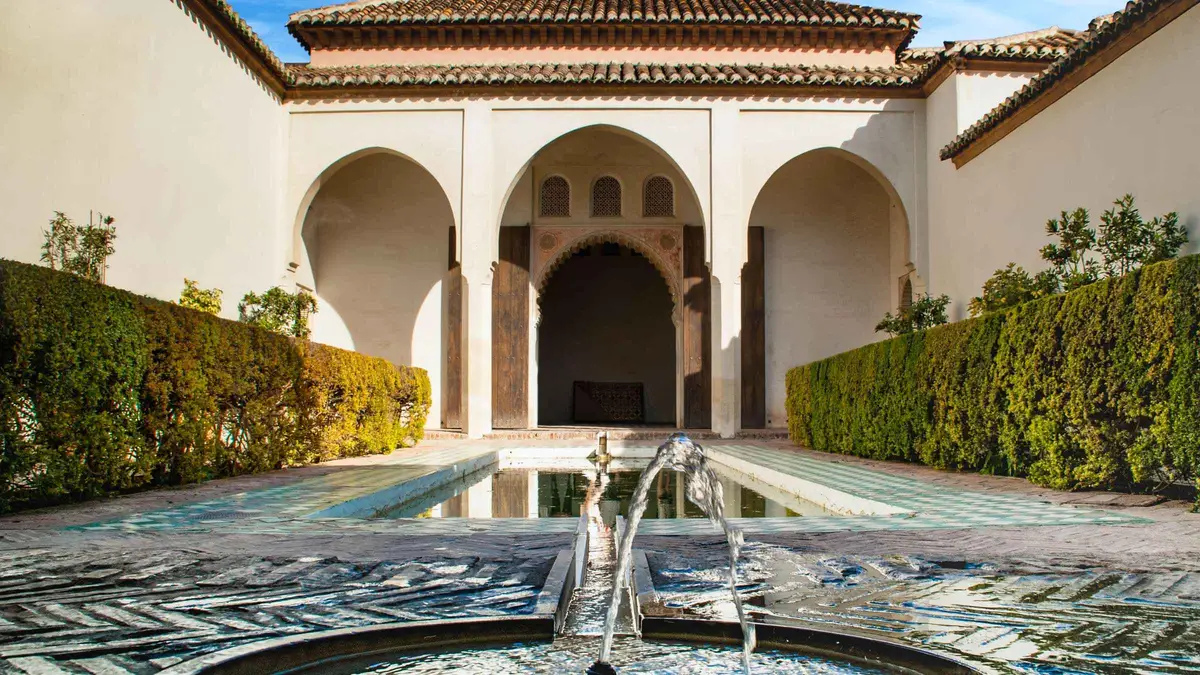
The Nasrid palace is two courtyards: the Patio de los Naranjos with its two original pools and tiled paving, and the Patio de la Alberca with one long pool. The permanent exhibition of ceramics from the site runs through its rooms in seven units. Beyond, the Barrio Castrense, eight eleventh-century houses on narrow lanes with their own hammam, is the best-preserved corner of the whole hill and closed to visitors under a protective roof. At the eastern end the Torre del Homenaje stands as the official page describes it, an imposing ruin.
How Much Time To Give the Alcazaba
The monument publishes no visit length, and no reseller listing we read gives one either beyond the 90 minutes of the guided walks. The figures below are our routing, built from the official route description, the 20-minute climb the castle page publishes and the theatre next door. Door to door means from the ticket office on Calle Alcazabilla and back to street level.
The variable is the second hill. The Alcazaba on its own fits inside an hour and a half at a walking pace. Adding Gibralfaro turns it into a morning, because the Coracha path is steep and the castle's walkway is a full circuit of the ramparts.
| Routing | On the hill | Door to door | What it skips |
|---|---|---|---|
| Gates and palaces only | About 1 hour | About 1 h 15 with the theatre viewed from the street | The gardens at length, the walls, Gibralfaro |
| Full Alcazaba with gardens and walls | About 1 h 30 | About 2 hours with the free Roman Theatre inside | Gibralfaro Castle |
| Alcazaba, then the Coracha climb to Gibralfaro | About 3 hours | About 3 h 30 with the walk back down | Nothing, but plan lunch afterwards, not before |
| With the 90-minute guided walk | 1 h 30 plus your own time inside | About 2 hours | Gibralfaro. The guide leaves you inside the Alcazaba |
Two adjustments. In July and August the official closing is 20:00, so a 17:30 start puts you on the walls in the only cool light of the day and still inside the last-admission rule. In winter the site shuts at 18:00 with last entry at 17:00, and the Coracha climb in the dark is not something to plan.
The itinerary that uses this order is Málaga in one day.
Alcazaba Opening Hours, the Free Sunday and What the Official Page Does Not Say
Two seasons, one last-admission rule and a free window every week. The official hours page is short. What it leaves out is as useful as what it prints.
Summer runs 1 April to 31 October, 09:00 to 20:00, last admission 19:00. Winter runs 1 November to 31 March, 09:00 to 18:00, last admission 17:00. The rule is printed in both languages: the last admission is one hour before closing, and the ticket desk applies it to the minute. Every Sunday from 14:00 admission is free for everyone, not only residents, and that window applies to Gibralfaro too, which makes it the single most crowded stretch of the week on both hills. If you want the free entry, arrive at 13:50 and go straight up. If you want the place to yourself, pay $8.16 (€7) on a weekday at 09:00.
The official page prints no closed dates at all. There is no line about 25 December, 1 January or 6 January, and the Ayuntamiento's press office has not published a holiday timetable for the two monuments that we could read. Treat those three days as open until the gate says otherwise, and do not rely on a reseller's calendar, which is generated from availability rather than from the monument. Third-party sites also list free entry on 28 February, 18 May and 27 September. The official price page does not print those dates, so this guide does not either. The full week of free windows across the city, from the Picasso museum's Sunday hours to the Junta's museum, is on Sunday and Monday openings.
- Reduced fare, $3.50 (€3): European Youth Card holders, EU citizens over 65, retired or unemployed, EU students with proof, disability of 33% or more, large-family card holders. Accreditation is asked for at the gate
- Free: children under 6, official guides at work, journalists with authorisation from the Department of Culture
- Group rate from more than 10 visitors, $5.83 (€5) single and $9.32 (€8) combined
- No dress code, no photography rule and no bag-size limit is published. The Roman Theatre next door does require authorisation for filming
Getting In: the Ramp, the Lift on Calle Guillén Sotelo, and Where the Theatre Fits
There are two ways into the monument and the official page names both. The difference is the cobbled ramp and the first three gates.
The Main Entrance on Calle Alcazabilla
The ticket office and gate are at Calle Alcazabilla 2, directly beside the Roman Theatre and its glass pyramid. From here the route is the one described above: a ramped, cobbled passage through three bent gates to the lower enclosure and a fourth to the upper one. The operators of the guided walks list the route as unsuitable for wheelchairs and for anyone with mobility problems, and one of them writes that there is no lift on its itinerary.
The monument itself publishes no accessibility statement beyond the lift. Comfortable shoes and, from June to September, water and a hat: the passage is in the sun for most of its length.
The Lift From Calle Guillén Sotelo
The official visit page describes a room in the upper enclosure that serves as an entrance for visitors who use the lift leading to Calle Guillén Sotelo. Calle Guillén Sotelo runs along the south side of the hill above the Paseo del Parque, on the opposite flank from the Alcazabilla gate. The lift brings you up inside the walls near the palaces, so you see the gates on the way down rather than on the way up.
What the official site does not publish is the lift's operating hours, whether it runs every day, or its capacity, and one reseller page states that it is currently out of service without a date. If the lift is the reason you are visiting, email the monument at [email protected] or ask at the Alcazabilla ticket office before you walk round to the far side of the hill. The walk between the two entrances is about ten minutes, our estimate.
The Roman Theatre Is Not Inside the Ticket, and Does Not Need To Be
The theatre at the gate belongs to the Junta de Andalucía, not to the Ayuntamiento, and is free at all times: Tuesday to Saturday 10:00 to 18:00, Sundays and holidays 10:00 to 16:00, closed on Mondays. The Alcazaba ticket does not include it and no combined ticket exists. Guided walks that bundle the two are bundling a free site with a paid one, which is not a fault, but it is worth knowing what the price is for.
The theatre's own page is the Roman Theatre guide, and on a Monday, when the theatre is shut, the terrace above it on Calle Alcazabilla shows the whole cavea for nothing.
Getting to Calle Alcazabilla
From the Cathedral the gate is about 300 metres east along Calle Císter and Calle Alcazabilla, five minutes on foot. From María Zambrano station it is about 25 minutes on foot through the centre, our estimate. The bus that serves the hill, EMT line 35, runs to Gibralfaro Castle, not to the Alcazaba.
The practical detail of fares and lines is on getting around Málaga. The monument publishes no visitor parking, and Calle Alcazabilla itself is pedestrian.
Five Things Most Visitors Do Not Know About the Alcazaba
Each of these came off an official page rather than a guidebook, and each carries its source.
- The columns holding up the second gate are Roman. The Puerta de las Columnas takes its name from the two shafts and capitals quarried from the theatre at the foot of the hill (Ayuntamiento de Málaga, official visit page).
- The upper gate you walk through was rebuilt from drawings. The Puerta de los Cuartos de Granada was largely demolished in 1854 and reconstructed in the twentieth century from historical illustrations (Wikipedia, Alcazaba of Málaga, citing the monument's own Recinto Superior page).
- The best-preserved district is the one you cannot enter. The Barrio Castrense, eight eleventh-century houses with their own bath, survives because it was never rebuilt, and it is closed to the public under a protective roof (Wikipedia, Alcazaba of Málaga, citing the Recinto Superior page).
- The free Sunday is not a residents' perk. The official price list makes admission free for all visitors every Sunday from 14:00, with no proof of address (alcazabaygibralfaro.malaga.eu, price list and visiting hours).
- The monument has no published closing dates, no published visit length and no audio-guide price. The English hours page prints seasons and fares only. An audio-guide page exists on the site without a fare (alcazabaygibralfaro.malaga.eu, read in Q3 2026).
- The garden you photograph is a twentieth-century design. The Plaza de Armas garden was laid out by the architect Fernando Guerrero-Strachan Rosado over the buried remains of a mosque and a post-1487 parish church (Ayuntamiento de Málaga, official visit page).
At the Alcazaba: What To Do, and What Not To
Every line here is a decision argued somewhere above, compressed into the form you can act on that morning.
Do
- Buy the $11.65 (€10) combined ticket at the Alcazabilla gate if Gibralfaro is on the same day. Two singles cost $16.32
- Arrive at 09:00 on a weekday for the palaces without a queue, or at 13:50 on a Sunday if the free window is the point
- Walk the Roman Theatre first, while it is open. It shuts at 18:00 and at 16:00 on Sundays, hours before the fortress does
- Take the 90-minute guided walk if you want the five gates explained. It ends inside and you stay as long as you like
- Carry water from June to September. There is no shade on the entrance ramp and no café inside the walls is published
Don't
- Don't pay a reseller $18.61 for an entry card the gate sells for $8.16. There is no line to skip
- Don't plan around the Calle Guillén Sotelo lift without asking first. The official page names it but publishes no hours
- Don't arrive after 19:00 in summer or 17:00 in winter. Last admission is one hour before closing and the desk holds to it
- Don't expect to walk from the Alcazaba into Gibralfaro inside the walls. The Coracha path is outside the ticketed enclosures and the castle has its own gate
- Don't bring a pushchair up the ramp. The route is cobbled and stepped and the operators rule it out for reduced mobility
Alcazaba Málaga Map: Both Entrances, the Theatre and the Climb to Gibralfaro
The ticket office on Calle Alcazabilla, the lift street on the far side of the hill, the free theatre at the gate, the castle above and the three sights within five minutes on foot.
The Alcazaba, theatre, castle and museum coordinates are the ones on their Wikidata items. The lift pin is our reading of the official description of Calle Guillén Sotelo and should be treated as the street, not the door.
Next Stop From the Alcazaba
Three things at the gate or a short climb away, each with its own page. Walk minutes are our estimates from the published distances.
Roman Theatre
The first-century theatre the Alcazaba's gate columns came from. Free, run by the Junta, Tuesday to Sunday only. The Roman Theatre is the one stop to do before the fortress, because it closes first.
At the gateGibralfaro Castle
The Nasrid castle at 132 metres, with the walkway round the walls and the best view of the port. The $11.65 (€10) combined ticket covers it. Gibralfaro Castle explains the three ways up and which one to take down.
20 min uphill, or bus 35Museo de Málaga
The Junta's fine-arts and archaeology museum in the Aduana building at the foot of the hill, free for EU citizens and $1.75 (€1.50) for everyone else. Museo de Málaga holds the finds from the hill you have just climbed.
2 min walkAlcazaba Málaga Questions
Is the Alcazaba in Málaga worth visiting?
Yes, and it is the one paid monument in the city centre that costs under ten euros. For $8.16 (€7) you get the five bent gates, the eleventh-century Taifa arcade, the two Nasrid courtyards with their original pools and the view over the port from the walls. The combined ticket with Gibralfaro Castle at $11.65 (€10) is the better buy if you have a morning. The guided walk with entry is the way to have the gates explained rather than just climbed.
Is entry to the Alcazaba free?
Every Sunday from 14:00 it is free for everyone, with no residency test, and it is free at all times for children under 6. On every other day it is $8.16 (€7), or $3.50 (€3) for the reduced categories. The Roman Theatre at the gate is free all week except Mondays. The Alcazaba tickets page has the full ladder, and the free-Sunday map lists the other museums that open free the same afternoon.
How long does it take to walk up the Alcazaba?
About 15 minutes from the Calle Alcazabilla gate to the upper enclosure at a steady pace, through three bent gates and a cobbled ramp. The whole visit runs about an hour, an hour and a half with the gardens and the walls. Continuing to Gibralfaro Castle adds a separate 20-minute climb on the Coracha path, which the castle's own page times. The routings are set out in the time section above, and Málaga in one day places the climb in the morning.
What are the Alcazaba's opening hours?
09:00 to 20:00 from 1 April to 31 October and 09:00 to 18:00 from 1 November to 31 March, every day, with last admission one hour before closing. No closed dates are printed on the official page. Gibralfaro keeps the same hours, so a combined-ticket visit can be planned on one timetable. The hours section above sets out the reduced fares and the free window.
Is there a lift into the Alcazaba?
The official visit page names a lift from Calle Guillén Sotelo, on the south side of the hill behind the Ayuntamiento, that brings visitors into the upper enclosure near the palaces. It publishes no operating hours, and a third-party site reports it out of service without a date, so ask at the Alcazabilla ticket office or email the monument before you walk round. The access section above gives the detail. The guided walks use the ramp and rule out wheelchairs.
What is the history of the Alcazaba in Málaga?
A Phoenician hill from about 600 BC, a Roman theatre on its slope in the first century, an Umayyad fortress recorded under Abd al-Rahman I in 755, then the palace-fortress the Hammudids began in the early eleventh century and the Nasrid emirs Yusuf I and Muhammad V rebuilt between 1333 and 1391. It fell to Ferdinand and Isabella on 18 August 1487, decayed into a residential district, and was restored from 1933 by Leopoldo Torres Balbás. The ten-date timeline above has the sources, and the siege of 1487 tells the summer it changed hands.
Can you walk from the Alcazaba to Gibralfaro Castle?
Yes, but not inside the walls. The Coracha, the fortified corridor between the two, is visible from the path but the two monuments have separate gates and separate ticket checks. The official castle page times the walk up the Paseo de Don Juan Temboury at about 20 minutes. EMT bus 35 is the alternative from the centre. The combined ticket covers both gates, and Gibralfaro Castle explains which way to go down.
Where the Alcazaba Fits in a Málaga Day
Start at the Roman Theatre when it opens at 10:00, or at the Alcazaba gate at 09:00 if it is a Monday and the theatre is shut, and be through the five gates before the guided groups arrive at eleven. With the combined ticket, take the Coracha path up to Gibralfaro Castle from the Alcazaba foot and come down by bus 35 to the Paseo del Parque, which leaves the afternoon for the Picasso Museum three minutes from the theatre or the Cathedral five minutes west. If you only have one day, this is the morning of Málaga in one day.
With two, the hill takes the first morning and the beaches of La Malagueta the second afternoon. Whether to do one hill or both, and in which order, is argued on Alcazaba or Gibralfaro. The rest of the city is ranked on things to do in Málaga and the trip starts on the Málaga guide homepage.
The Alcazaba on Film: the Gates, the Palaces and the Walls
Three walk-throughs that show what the ticket buys: the climb through the bent gates, the Taifa arcade and the courtyards, and the view from the ramparts over the port.
The Alcazaba of Málaga | 4K Walking Tour
An unedited walk from the Alcazabilla gate to the upper palaces, the best way to judge the ramp and the steps before you go.
Video: SlowologyVisiting Alcazaba of Málaga | Málaga Travel & History
The palaces and gardens with the history said out loud, close to what the guided walks cover.
Video: Hair BuddhaWhy Alcazaba of Malaga is a MUST VISIT Destination in 2024
The courtyards, the pools and the walls in daylight, useful for deciding between the single and the combined ticket.
Video: Nomadic AdventuresVideos load from YouTube only when you press play.
Prices, hours and terms are set by the venue or operator and confirmed at checkout.
We may earn a commission if you book through one of our links, at no extra cost to you. Full affiliate disclosure