 Malaga City Guide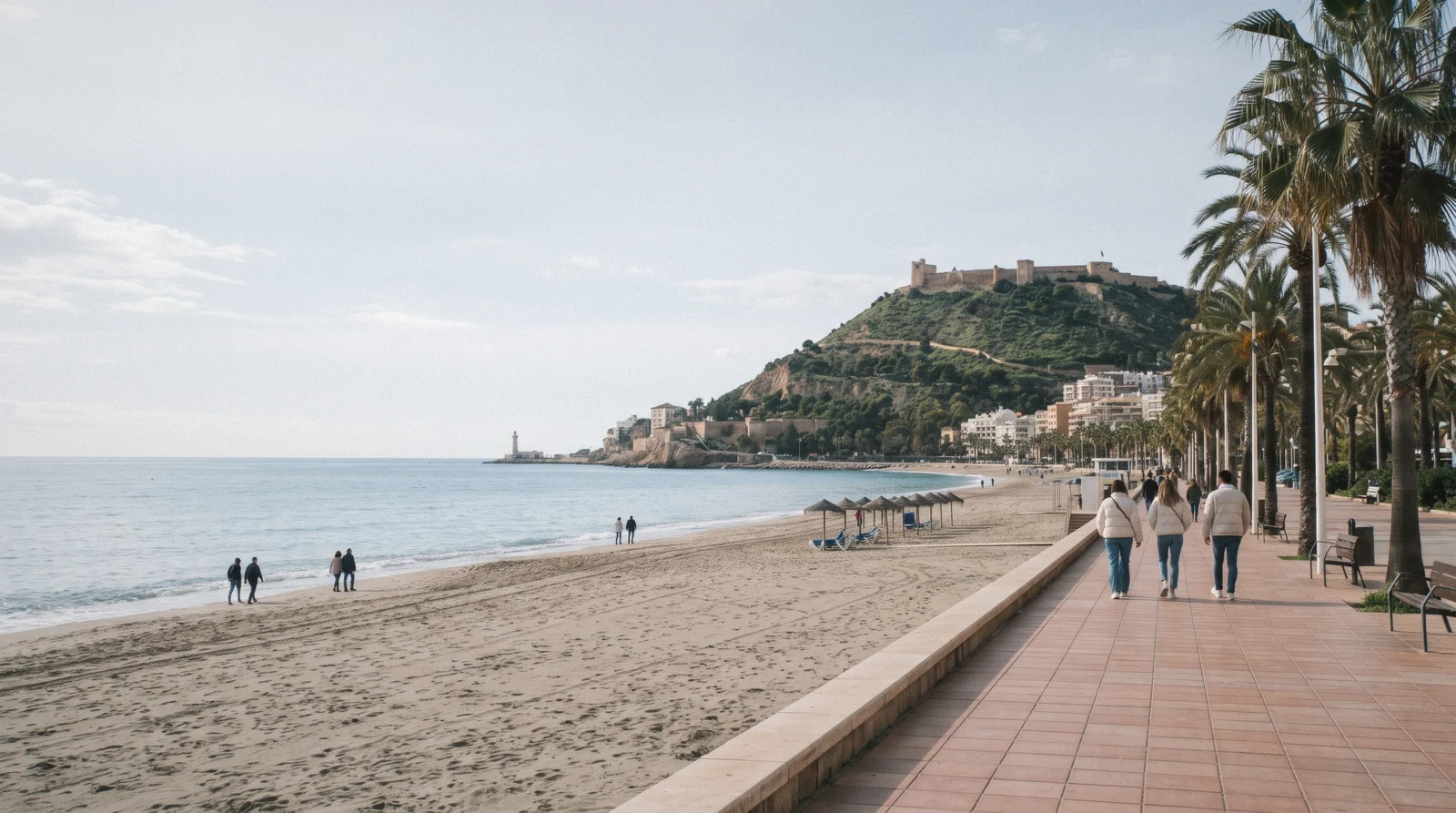
Málaga Weather by Month
Málaga weather is the reason the city has a year-round tourist season, and the numbers bear the reputation out: 2,905 hours of sunshine a year at the airport station, a January average high of 15.4°C (60°F), and only 42 days a year with a millimetre of rain or more. What the reputation hides is a real wet season from November to January and two summer months whose 29.2°C (85°F) average high closes down the middle of the day. Every figure on this page comes from two public datasets, the Open-Meteo ERA5 reanalysis for the city centre over 1995 to 2024 and AEMET's climate normals for Málaga Aeropuerto, read in Q3 2026. The month you choose with them is a separate decision, made on the best time to visit page. The rest of the trip sits on this independent Málaga guide.
Quick answer The hottest and coldest months, the wet season and the sea, in three lines
Málaga's average high runs from 15.4°C (60°F) in January to 29.2°C (85°F) in July and August on the thirty-year ERA5 series, and no month averages below 9.6°C (49°F) at night. Rain is concentrated: November, December and January carry 59 to 73 mm each, while July averages 2 mm across 1.3 rainy days. Sunshine at the airport runs from 160 hours in December to 347 in July.
Key takeaways
- The comfortable walking months are March to May and September to October, with highs of 17.8°C to 26.0°C (64°F to 79°F). The month-by-month verdicts turn those figures into dates
- July and August are the only months with average highs above 27°C, which is when the Alcazaba's ramparts have no shade and a guided Alcazaba walk with a guide who knows the shaded gates earns its fee
- The sea has a lifeguard season, 15 June to 15 September, but no published monthly temperature. A swim stop off a catamaran only runs when the operator judges conditions safe
- The wettest month is a tie: ERA5 gives December 73 mm and November 72 mm, AEMET gives both 100 mm. That is when the free Sunday museum hours matter most
Málaga Month by Month
Average daily high temperature by month in Celsius, with the Fahrenheit reading underneath, computed from the Open-Meteo ERA5 reanalysis for 36.72 N, 4.42 W over the thirty years from 1995 to 2024. The season bands under the bars are explained in the note.
The temperature bars are ERA5 monthly means of the daily maximum. The bands are ours: the good months are those with average highs between 17°C and 26°C and fewer than eight rainy days. The warm band is the three months whose highs pass 26°C. The wet band is the three months with the highest rainfall on both datasets. The busy band is a reading of the calendar, Semana Santa in late March or April, school holidays in July and August and the Feria in the third week of August, because no authority publishes a monthly visitor count for the city.
Málaga Weather by Month: The Figures
Thirty-year averages from the Open-Meteo ERA5 archive for the city centre, 1 January 1995 to 31 December 2024, computed in Q3 2026: the mean of the daily maximum and minimum, and the mean monthly rainfall total. The sunshine column is AEMET's 1981 to 2010 normal for station 6155A, Málaga Aeropuerto, which is the only official sunshine series for the city.
| Month | Average high | Average low | Rain (ERA5) | Sun hours (AEMET) |
|---|---|---|---|---|
| January | 15.4°C (60°F) | 9.6°C (49°F) | 59 mm | 180 |
| February | 16.1°C (61°F) | 10.0°C (50°F) | 44 mm | 180 |
| March | 17.8°C (64°F) | 11.3°C (52°F) | 60 mm | 222 |
| April | 19.6°C (67°F) | 13.0°C (55°F) | 41 mm | 244 |
| May | 22.6°C (73°F) | 15.7°C (60°F) | 26 mm | 292 |
| June | 26.5°C (80°F) | 19.3°C (67°F) | 8 mm | 329 |
| July | 29.2°C (85°F) | 22.0°C (72°F) | 2 mm | 347 |
| August | 29.2°C (85°F) | 22.5°C (72°F) | 5 mm | 316 |
| September | 26.0°C (79°F) | 19.8°C (68°F) | 27 mm | 255 |
| October | 22.7°C (73°F) | 16.8°C (62°F) | 55 mm | 215 |
| November | 18.6°C (65°F) | 12.9°C (55°F) | 72 mm | 172 |
| December | 16.1°C (61°F) | 10.8°C (51°F) | 73 mm | 160 |
The ERA5 grid point returned for the city-centre coordinates sits at 36.73 N, 4.37 W at 22 metres, a few kilometres east of the Cathedral, so the figures describe the coastal strip rather than the Montes de Málaga behind it. The Fahrenheit readings are rounded conversions of the Celsius means, not separate measurements. AEMET's own temperature normals for the airport run about a degree warmer by day and two degrees cooler at night than ERA5, which is the usual gap between a reanalysis grid and a station on open ground.
Two Datasets, One City, and Where They Disagree
There are two honest ways to describe Málaga weather in numbers and they do not quite agree, so both are printed. The disagreement is itself useful: it shows how much a rainy month can vary.
ERA5 is a reanalysis, a weather model run backwards over observations, which gives a continuous thirty-year series for any point on the map. AEMET's normals are the airport station's own instruments, averaged over 1981 to 2010. The temperature curves are close.
The rain figures are not, and the difference falls exactly where a visitor would care. AEMET's airport gauge records 100 mm in both November and December against ERA5's 72 and 73 mm, and 69 mm in January against 59. Summer is dry on both: AEMET records 0 mm in July and 0.1 rainy days, ERA5 2 mm and 1.3 days.
| Month | ERA5 rain | ERA5 rainy days | AEMET rain | AEMET rainy days |
|---|---|---|---|---|
| January | 59 mm | 7.6 | 69 mm | 5.8 |
| February | 44 mm | 6.4 | 60 mm | 4.8 |
| March | 60 mm | 7.6 | 52 mm | 4.0 |
| April | 41 mm | 6.9 | 44 mm | 4.5 |
| May | 26 mm | 4.5 | 20 mm | 3.1 |
| June | 8 mm | 2.0 | 6 mm | 0.8 |
| July | 2 mm | 1.3 | 0 mm | 0.1 |
| August | 5 mm | 1.9 | 6 mm | 0.5 |
| September | 27 mm | 3.7 | 20 mm | 2.1 |
| October | 55 mm | 6.3 | 57 mm | 4.4 |
| November | 72 mm | 7.1 | 100 mm | 5.6 |
| December | 73 mm | 7.6 | 100 mm | 6.6 |
How to read the gap
A rainy day on both series is a day with at least one millimetre. ERA5 counts more of them and AEMET records more water, which describes Málaga rain well: it comes in short, heavy episodes rather than grey weeks. A November total of 100 mm across 5.6 days is around 18 mm per rainy day, so the pattern is a wet afternoon followed by two clear ones, not a fortnight of drizzle. That is why a winter trip here rarely loses more than a day, and why the museum free hours on Sunday afternoons are worth placing on the day the forecast marks wet.
AEMET's annual figures for the airport are 534 mm of rain over 42.3 rainy days and 2,905 hours of sunshine. Humidity peaks at 72 per cent in December and bottoms at 58 per cent in June and July, so the summer heat is dry heat, which is easier to walk in than the number suggests and harder to notice until you are dehydrated.
Málaga in Every Month of the Year
One paragraph per month, built from the figures above and from the dates the city's own institutions publish. The verdict on which month to pick lives on the best time to visit page. This section is what each month is actually like.
Málaga in January
The coldest month, and still a 15.4°C (60°F) average high with nights at 9.6°C (49°F). Rain is 59 mm on ERA5 and 69 mm at the airport, spread over six to eight days, and the sun manages 180 hours. The Alcazaba and Gibralfaro are on winter hours, 09:00 to 18:00 with last entry at 17:00, and the Picasso Museum closes at 18:00, so days are planned around a 17:00 cut-off rather than the light.
The 1st and the 6th are public holidays, and the Roman Theatre, the Museo de Málaga and the Alcazaba's own shop treat them differently. The tickets index has the closures. The sunset catamarans are cut to one hour in January, as their listings state.
Málaga in February
A shade warmer at 16.1°C (61°F) and noticeably drier than January at 44 mm on ERA5, though AEMET's airport gauge still records 60 mm. The 28th is Día de Andalucía, a regional holiday on which the Picasso Museum, Casa Natal Picasso and Centre Pompidou all open free of charge, which makes it the cheapest museum day of the year. The Festival de Málaga's warm-up programme, MaF, runs from mid-February.
Evenings need a coat: the average low is 10.0°C (50°F), and the tuk-tuk operators fit rain and wind covers for a reason.
Málaga in March
The first walking month, 17.8°C (64°F) by day, 11.3°C (52°F) at night, and 222 hours of sunshine, though ERA5 still counts 7.6 rainy days and 60 mm. The Festival de Málaga fills the first half of the month, 6 to 15 March in 2026 and 26 February to 7 March in 2027. In 2026 Palm Sunday fell on 29 March, so Semana Santa began in March.
The events calendar has the processional timetable and the shop-opening rules that come with it. From 30 March the Cathedral moves to its longer weekday hours, 10:30 to 19:30.
Málaga in April
April is 19.6°C (67°F) by day with 244 hours of sun and 41 mm of rain, the driest of the spring months. The Alcazaba, Gibralfaro and La Concepción switch to summer hours on 1 April, which adds two hours to the evening: the fortress stays open to 20:00 and the botanical garden to 20:30, with its free Sunday window moving to 16:30 to 20:30. Jueves Santo and Viernes Santo, 2 and 3 April in 2026, are public holidays across Andalucía and the whole municipality is a free-trading zone for shops from Palm Sunday to Easter Sunday.
This is the month the Caminito del Rey calendar starts to fill. The Caminito tickets page explains the timed, named ticket.
Málaga in May
The best all-round month on the figures: 22.6°C (73°F) by day, 15.7°C (60°F) at night, 292 hours of sunshine and only 26 mm of rain over four and a half days. The 1st is a public holiday. The 18th, International Museum Day, opens the Picasso Museum, Casa Natal, the Pompidou and the Carmen Thyssen free, and the Thyssen even opens on that Monday.
The Noche en Blanco, the city's one-night free culture festival, was Saturday 16 May in 2026, 20:00 to 01:00. The sea is not yet in season: lifeguards work weekends only until 15 June, and the catamaran swim stops begin in May by the operators' own listings.
Málaga in June
June steps up to 26.5°C (80°F) with 329 hours of sunshine and 8 mm of rain across two days. The humidity drops to 58 per cent. The bathing season opens on 15 June with lifeguards daily on the city beaches and the accessible bathing points staffed from that date.
From 1 June the whole municipality is declared a zone of high tourist influx for shop hours, which means Sunday opening through to 30 September. The night of the 23rd is San Juan, the one night the beach ordinance allows fires on the sand, from 10:00 on the 23rd to 21:00 on the 24th. The Cathedral's summer weekday hours, 10:30 to 20:00, begin on 1 June.
Málaga in July
The hottest month with August, 29.2°C (85°F) by day and 22.0°C (72°F) at night, 347 hours of sunshine and effectively no rain: 2 mm on ERA5, 0 mm at the airport. The beaches index names 12:00 to 15:00 and 17:00 to 19:00 as the busiest hours in July and August. The Picasso Museum runs its longest hours, 10:00 to 20:00, with the free Sunday window at 18:00 to 20:00.
The Virgen del Carmen procession on the 16th brings the fishing barrios out onto the sand at Pedregalejo and El Palo. Plan the Alcazaba for 09:00 or after 18:00 and keep the middle of the day for the sea or a museum. The with-kids page has the indoor list.
Málaga in August
Same 29.2°C (85°F) high as July, a warmer 22.5°C (72°F) night and 316 hours of sun. The Feria de Málaga ran 15 to 22 August in 2026, with the daytime fair in the historic centre ending at 18:00 each day and the 19th a local holiday. Several museums shorten their hours: the Carmen Thyssen runs 10:00 to 15:00 from 15 to 23 August, the Cathedral takes no visits on the 15th and 16th and closes at 14:30 from the 17th to the 22nd, and the Museo del Vidrio shuts for the whole month.
The events calendar sets all of that out. The 15th is also a national holiday.
Málaga in September
September cools to 26.0°C (79°F) by day and 19.8°C (68°F) at night, with 255 hours of sun and the first rain since May, 27 mm over about four days. The 8th, Virgen de la Victoria, is a local holiday on which the Museo de Málaga opens and most shops do not. The bathing season and daily lifeguards end on the 15th, and the Sunday shop-opening freedom ends on the 30th.
The Picasso Museum's free day on the 27th, World Tourism Day, is the last of its dated free days before its anniversary on 27 October. For walking the Gibralfaro path or the Montes de Málaga trails, the second half of the month is the first comfortable window since May.
Málaga in October
October is 22.7°C (73°F) by day, 16.8°C (62°F) at night, 215 hours of sun and 55 mm of rain over about six days, so the first real wet afternoons return. The 12th is a national holiday, and the Carmen Thyssen opens that Monday. La Concepción's free Sunday window moves back to 14:00 to 17:30 on 1 October.
On the 26th the Cathedral drops to winter weekday hours, 10:30 to 18:30. The Alcazaba and Gibralfaro keep summer hours to the 31st, so an October evening can still end on the castle terrace at 19:30. The Alcazaba tickets page has the combined fare.
Málaga in November
The wet season proper: 72 mm on ERA5, 100 mm at the airport, 172 hours of sun, 18.6°C (65°F) by day. The 1st of November holiday moved to Monday the 2nd in 2026. On the 1st the Alcazaba, Gibralfaro and La Concepción go to winter hours and the Picasso Museum closes at 18:00.
The Christmas lights on Calle Larios were switched on at 18:30 on Friday 28 November in 2025, with the 2026 date announced by the Ayuntamiento in November. November is still a 15°C afternoon most days, and the museum layer of the city, priced on the costs page, does not care about rain.
Málaga in December
December ties November as the wettest month, 73 mm on ERA5 and 100 mm at the airport, with the year's least sunshine at 160 hours and highs of 16.1°C (61°F). The 7th and 8th are public holidays in 2026, and the Thyssen opens on Monday the 7th. Calle Larios' light-and-sound show ran at 18:30, 20:30 and 22:00 through to 4 January in the 2025 season, with the lights themselves on until 02:00 from Thursday to Saturday and until 06:00 on the 24th and 31st.
The Picasso Museum, Casa Natal, Pompidou and Museo Ruso all close at 15:00 on the 24th and 31st and shut on the 25th. The Caminito del Rey closes on the 24th, 25th and 31st. The sunset cruises run one hour, not ninety minutes, in December.
Rain: When It Falls and What It Closes
The Málaga rainy season is short and front-loaded into the winter. Over the thirty-year ERA5 series the six months from October to March carry 363 of the year's 472 mm. May to September together carry 68.
What a wet day actually costs depends on where you were going. Inside the city it costs nothing: the Alcazaba's inner palace, the Picasso Museum, the Museo de Málaga, the Pompidou and the Carmen Thyssen are indoor, and the Roman Theatre is a five-minute look either way. The two things a wet day does close are outside the city.
The Caminito del Rey publishes weather closures on its website and Telegram channel on the morning of the visit, and a closure gives you a four-day window to swap the date or take a refund. The Caminito page explains the one-way route and why a morning slot is the safer one in a wet month. The Teleférico at Benalmádena suspends in adverse weather without a published calendar, so a winter cable-car day is a phone call first.
The boats run, the swim stops do not
The bay cruises out of Muelle Uno state in their own listings that they sail rain or shine, that a departure delayed by up to an hour is not grounds for a refund, and that a swim stop happens only when the sea allows. So a sunset sail in a wet week is a sail under a grey sky, not a cancellation, and the 90-minute cruise with a swim stop is a bay cruise outside May to September whatever the weather. Read those three conditions before you book a boat for a November date.
Heat: What July and August Do to a Day
Two months average 29.2°C (85°F) and the airport station's own normals put the August mean maximum at 30.8°C. The heat is dry, 58 to 61 per cent humidity, which makes it deceptive rather than oppressive.
The places that suffer are the ones without a roof. The Alcazaba's ramparts and the Gibralfaro walls have no shade at all. The operator of the most-booked Alcazaba guided walk is praised in reviews specifically for keeping the group in the shaded gates. The Caminito del Rey's boardwalks hang on a south-facing cliff and its own recommendations page asks for at least 1.5 litres of water per person, with no toilets or water between the entry and the exit. The e-bike and vintage-bike operators run in summer but the climb to Gibralfaro on the castle-hill e-bike tour is an early-morning ride, not an afternoon one.
The practical shape of a July day is the one the Picasso Museum's hours suggest. Do the fortress at 09:00 when it opens, walk down the Coracha path before 11:00, spend 12:00 to 17:00 indoors, in the museum, in the market, or at the beach under an umbrella at the hours the city itself names as busiest, and come back out at 18:00 for the port. The Alcazaba's summer closing at 20:00, with last entry at 19:00, makes a second, cooler visit possible on the same ticket day if you enter after 18:00. The beach guide lists which of the 15 city beaches have shade and showers, and the Sunday afternoons when the museums are free, listed on the free things page, are the cheapest air conditioning in the city.
Sea, Sun Hours and the Bathing Season
The most-asked Málaga weather question has no official answer, and this section says so rather than borrowing a number.
Nobody publishes a monthly mean sea temperature for Málaga. Puertos del Estado runs a buoy off the city, station 1514, and its public chart shows the live water temperature only, not a climatology, so any table of monthly sea temperatures you find elsewhere is either a private estimate or a copy of one. What is published is the season: the Ayuntamiento's beach communiqué sets lifeguards on weekends before 15 June and daily from 15 June to 15 September, with accessible bathing points staffed from 15 June at Guadalmar, Misericordia, San Andrés, Malagueta, Caleta, Pedregalejo, El Palo and El Dedo. The beach ordinance defines the season more widely as 1 June to 30 September. Between those dates the water is warm enough that the swim stops on the bay catamarans run. The operators themselves list May to September for them.
Sunshine is the figure Málaga is sold on, and it is real. AEMET's airport normal is 2,905 hours a year, from 160 in December to 347 in July. Even the darkest month averages more than five hours of sun a day, which is why a December visit to the botanical garden at La Concepción or a winter walk along the Senda Litoral is a reasonable plan rather than a gamble.
| Season marker | Date | Source |
|---|---|---|
| Lifeguards on weekends | before 15 June | Ayuntamiento beach communiqué, 2025 season |
| Lifeguards daily | 15 June to 15 September | Ayuntamiento beach communiqué |
| Bathing season in the ordinance | 1 June to 30 September | Ordenanza de playas |
| Beach fires allowed | 10:00 on 23 June to 21:00 on 24 June | Ordenanza de playas, San Juan |
| Busiest beach hours | 12:00 to 15:00 and 17:00 to 19:00, July and August | malaga.eu beaches index |
| Blue Flag beaches, 2025 | Pedregalejo, La Caleta, El Palo, El Dedo, La Malagueta, La Misericordia, San Andrés | Ayuntamiento communiqué |
Forecasts, and What This Page Is Not
How hot Málaga will be next week is a forecast question, and this page is a climate page. The two should not be confused, so here is where the forecast lives.
The official forecast for the city is AEMET's, the Spanish state meteorological agency, published for the municipality of Málaga on aemet.es with hourly and seven-day views. The Caminito del Rey's operators and the Teleférico both make their closure decisions on the morning, so a forecast the night before is a guide, not a guarantee. For anything beyond ten days out, the thirty-year table above is a better predictor than any long-range forecast, which is why the best time to visit page plans on climate rather than on a forecast.
Two things this page does not do. It does not print a monthly sea temperature, because none is published. And it does not print the popular claim of 320 sunny days a year, because AEMET counts sunshine in hours, not days, and 2,905 hours is the figure that exists. Whether Málaga is cheap or expensive is a different question, answered on the costs page, but the weather is part of the answer: the wet-season months are the ones with the lowest room rates, which is the trade the where to stay page sets out.
Four Bookings the Weather Decides
The cards below are the bookings whose value changes with the month: a sunset cruise that shortens in winter, a swim stop that runs May to September, a gorge walk that closes on the morning of bad weather and a fortress walk that lives or dies by shade. Prices in USD as listed on the operator's page on in Q3 2026.
 from $15.12
Most reviewed
from $15.12
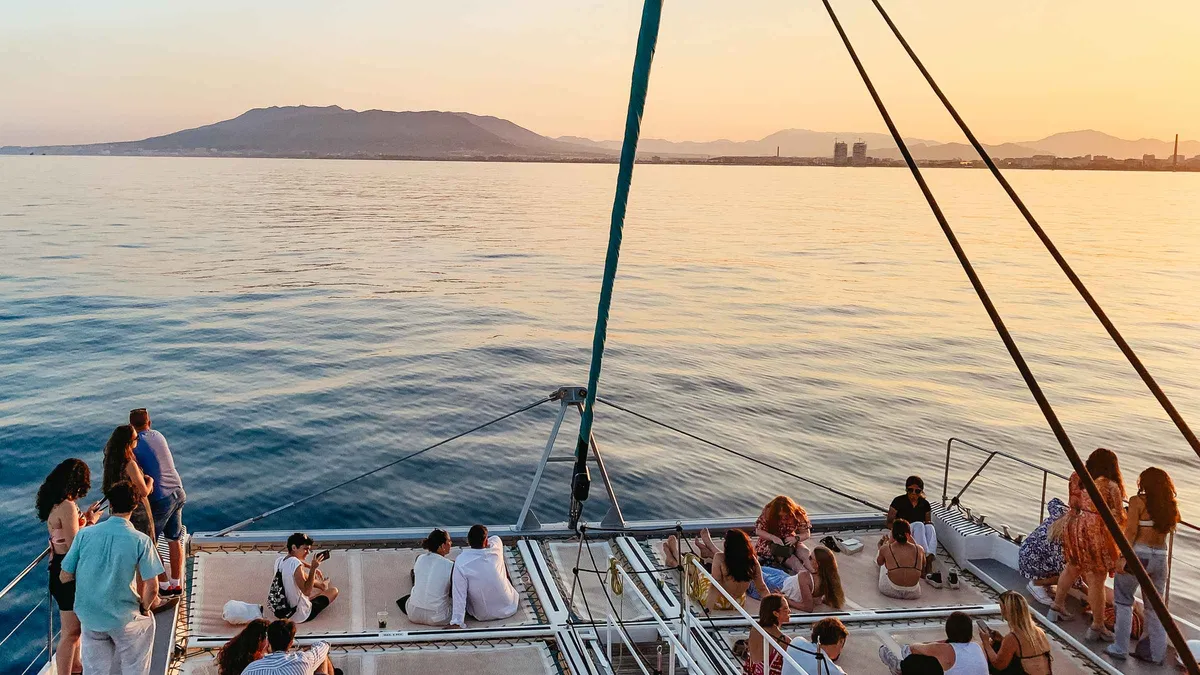
Most reviewed Malaga: Catamaran Sailing Trip with Sunset Option
The cheapest hour on the water in Malaga: a sailing catamaran out of the port at sunset with chill-out music, and cava only if you pay for that option. Bringing your own food and drink is not allowed. Live-music departures cost more and run three evenings a week until mid-September.
Check Availability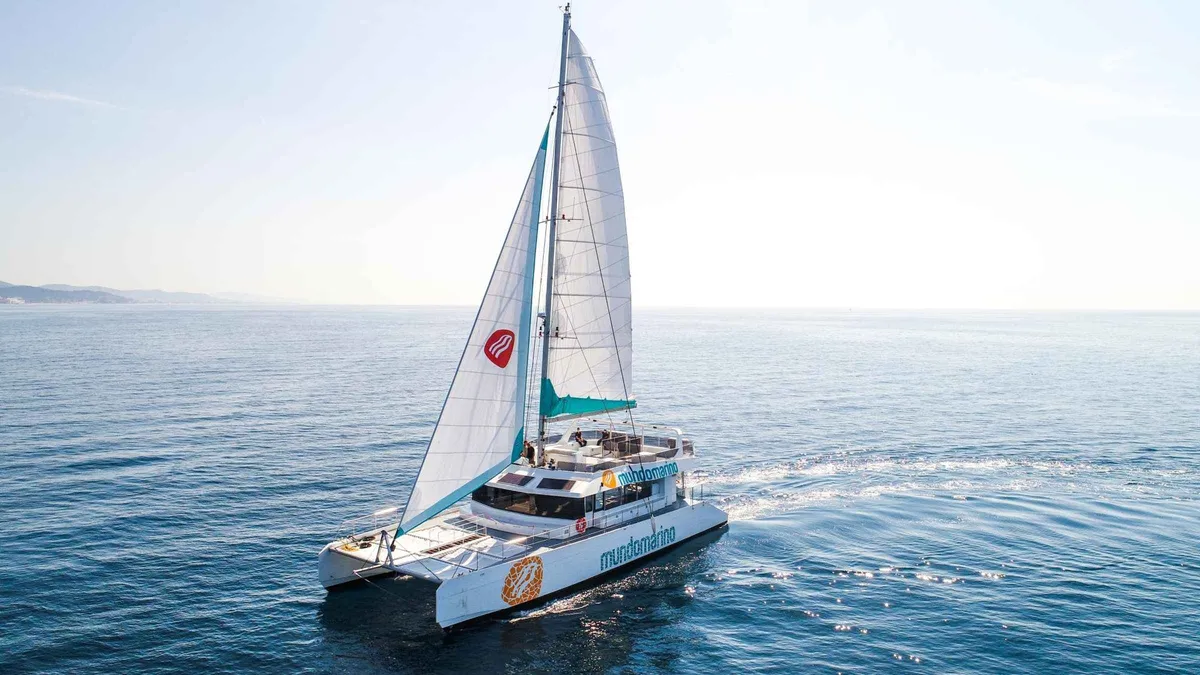 from $23.27
Malaga: Catamaran Sailing Cruise with Swimming & Optional DJ
Ninety minutes under sail from Muelle Uno with a swim stop when the sea allows and an optional DJ upgrade. The route changes with the wind, a souvenir photo is included, and the bar is pay-as-you-go. The lowest rating of the six bay cruises here.
Check Availability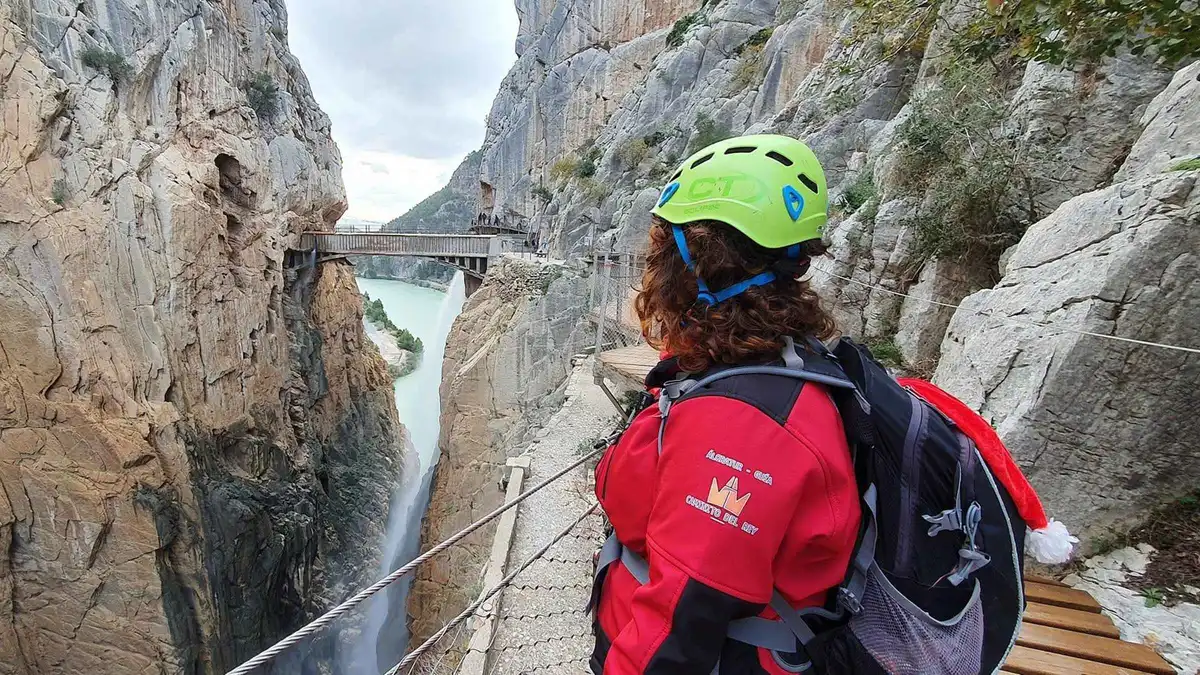 from $72.01
Most reviewed
from $72.01
Most reviewed Caminito del Rey Guided Tour & Welcome Pack from Málaga
The most-booked Caminito day from Malaga: a direct coach to the northern entrance, the entry ticket, an official guide and a welcome pack, with groups split by language and a defibrillator carried on the route. No meals. Under-8s cannot enter and over-65s must sign their own insurance form.
Check Availability from $14.66
Most reviewed
from $14.66
Most reviewed Málaga: Alcazaba and Roman Theatre Guided Tour With Entry
A 90-minute guided walk that starts at the Roman Theatre and ends inside the Alcazaba, fortress entry included, in English, Spanish or Italian. You are left inside the Alcazaba at the end to stay as long as you like; the tour does not go up to Gibralfaro Castle.
Check AvailabilityPrices, ratings and details are the platform's own; dollar figures are the listed prices — the platform bills in your account's currency.
From the Weather to the Dates
The three pages that turn a climate table into a plan.
Pick the month
The months compared by crowds, prices, events and the sea, with a verdict for each kind of trip: the best time to visit Málaga.
Decision pageWhat the fixed dates do
Semana Santa, the Feria, the Christmas lights and the free museum days, with the closures each one brings: the events calendar.
DatedThe beaches in season
Fifteen city beaches over 13.5 km, with the Blue Flags, the accessible bathing points and the chiringuitos: the beaches guide. The rest of the city is on the Málaga guide.
15 June to 15 SeptemberMálaga Weather: Questions
What is the weather in Málaga like year round?
Mild and sunny with a short wet winter. The ERA5 thirty-year average high runs from 15.4°C (60°F) in January to 29.2°C (85°F) in July and August. The airport records 2,905 hours of sunshine and 534 mm of rain a year, most of it from October to March. The full month table has every figure, and the best time to visit page turns them into dates.
What is the rainy season in Málaga?
November to January, with October and March as the shoulders. ERA5 gives November 72 mm, December 73 mm and January 59 mm. AEMET's airport gauge records 100 mm in both November and December. Rain comes in short heavy episodes, around 18 mm per rainy day in November, so a winter trip rarely loses more than a day. the two-dataset table shows the pattern, and the Sunday free museum hours are the wet-afternoon plan.
Is Málaga warm all year?
Warm by northern European standards, yes: no month averages a daytime high below 15.4°C (60°F) or a night below 9.6°C (49°F). It is not beach weather all year. Lifeguards are on the sand daily only from 15 June to 15 September, and no official monthly sea temperature exists to say otherwise. the sea section explains, and the beaches guide lists what is open in winter.
What is the sea temperature in Málaga by month?
Not published. Puertos del Estado's buoy off Málaga, station 1514, shows a live reading only, and neither AEMET nor the Ayuntamiento prints a monthly mean. The dated facts are the bathing season, 15 June to 15 September with daily lifeguards, and the operators' own May to September window for the swim stops on the bay catamarans.
How hot does Málaga get in July and August?
An average daily high of 29.2°C (85°F) on the ERA5 series and 30.8°C on AEMET's August normal, with nights at 22.0°C to 22.5°C (72°F) and almost no rain. Humidity sits near 58 to 61 per cent, so it is dry heat. The heat section sets out a day that avoids the ramparts at noon, and a guided Alcazaba walk keeps you in the shaded gates.
What is Málaga weather like in December?
Highs of 16.1°C (61°F), lows of 10.8°C (51°F), the year's least sunshine at 160 hours and its highest rainfall, 73 mm on ERA5 or 100 mm at the airport. It is a museum-and-lights month: Calle Larios' show ran at 18:30, 20:30 and 22:00 to 4 January in the 2025 season, and the events calendar carries the Christmas dates. The sunset cruise is cut to one hour, as the operator's listing says.
Which is the best weather month to visit Málaga?
May on the figures: 22.6°C (73°F) by day, 292 hours of sun and 26 mm of rain, before the beach season and the summer heat. September and October are close behind. The decision also depends on prices and the calendar, which is what the best time to visit page weighs. If the Caminito del Rey is the point of the trip, its tickets sell out weeks ahead in spring.
Málaga Weather on Film
Three films that show the weather rather than describe it: a plain explainer, the winter case, and what one of the wet-season storms actually looks like on the Costa del Sol.
What Is The Weather Like In Malaga?
A short explainer of the year's shape, the same seasons this page prints.
Video: Europe Travel Pros4 Reasons you SHOULD visit Malaga Spain in Winter
The case for the 15°C winter afternoons, filmed in the season the table calls wet.
Video: Brown ExpatsStorm Hits Malaga: Strong Wind and Rain on the Costa del Sol
A wet-season episode on camera, the short heavy kind the rainfall figures describe.
Video: Bogdan KosminVideos load from YouTube only when you press play.
Prices, hours and terms are set by the venue or operator and confirmed at checkout.
We may earn a commission if you book through one of our links, at no extra cost to you. Full affiliate disclosure